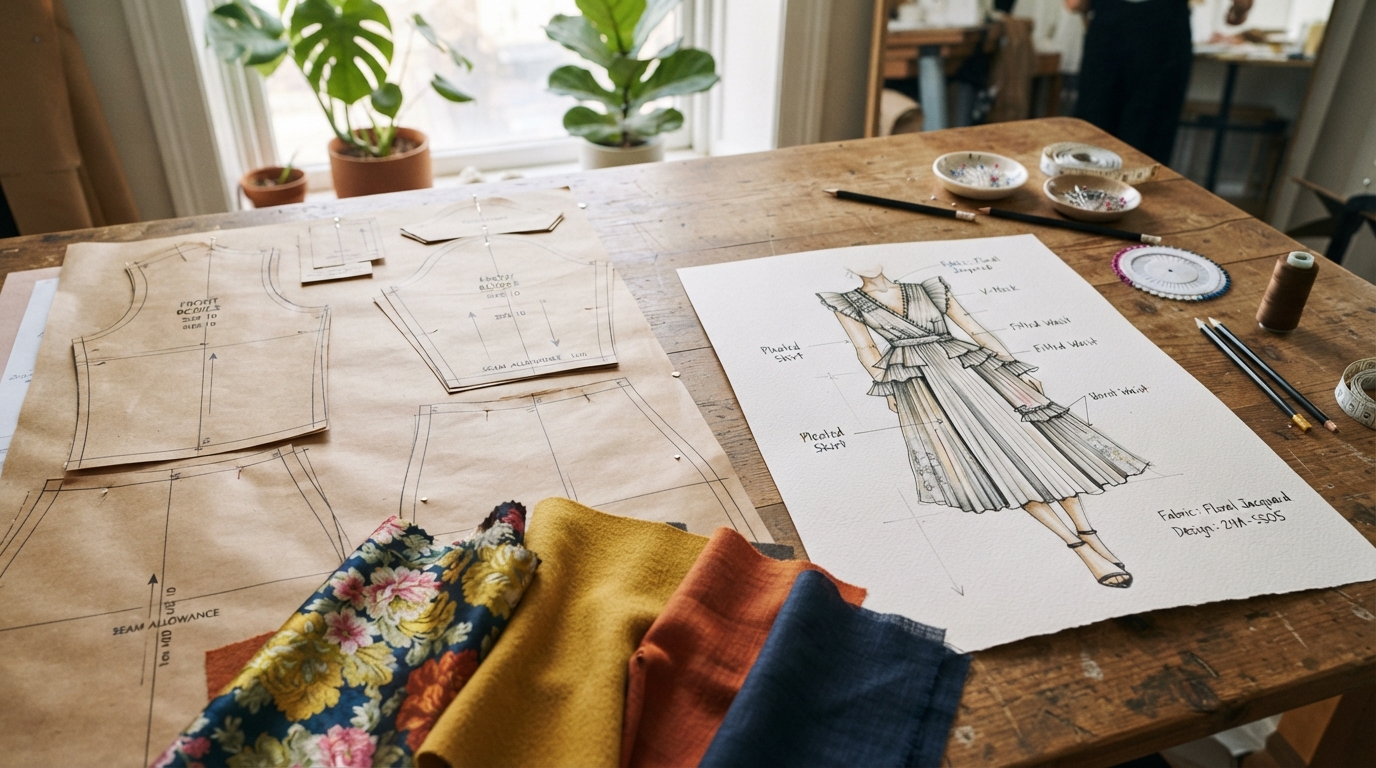
A garment design becomes wearable when we turn it into pattern pieces that guide fabric cutting and construction. Pattern making turns the sketch into a clear plan for fashion design, so modern designers can shape, cut, and sew fabric with purpose. A pattern piece is a two-dimensional template used to cut one section of a garment from fabric. When we sew the cut fabric pieces together, they form a garment that can be worn. These templates are not decorative fabric prints, which add color or images to cloth but do not guide garment construction. Accurate garment fit matters from the start: a sleeve, waist, or shoulder that misses its intended shape can change how the whole design looks and moves. We can use the right measurements and fit checks to keep those details on track. A successful pattern preserves the intended silhouette while allowing the garment to fit and move on a body.
Key Takeaways
- A pattern piece guides the cutting of one garment section.
- A block gives designers a fitted starting point for new styles.
- Drafting, draping, and CAD start from different places.
- A toile tests fit before a production pattern is approved.
- Paper tools and digital software support different tasks.
- Designers can build skills through measurement, fabric work, and digital practice.
What Is a Block, and How Does It Shape Fit?
A block is a fitted master pattern that designers adapt into other garment patterns. Also called a sloper, this foundation pattern gives us a measured base for fit and design changes. A block holds the basic shape before we add style details or extra room.
We can use blocks to create patterns for new garments without starting every design from scratch. The recorded measurements and basic shape give designers a steady point of reference. For more on pattern development and fit, see our guide to apparel design development.
The foundation pieces in a basic block
A basic set usually has a bodice front and back, a sleeve, and a skirt front and back. These pieces form a useful starting set for many garment patterns. A block is a master or foundation pattern used to develop other patterns and blocks.
The basic pattern has the darts needed to shape fabric around the body. It also has minimal wearing ease, or extra room beyond body measurements for comfort and movement. Designers add more ease and style features during pattern development, based on how the garment should look and feel.
Keep the block as a clear record of the fitted shape before adding new design features.
Ease and personalized fit
Ease helps fabric move with the body instead of pulling tight. A close-fitting top needs less extra room than a loose jacket, while fabric choice also affects how a garment feels. The right amount depends on both the design and the person wearing it.
A personalized block can improve fit for someone whose measurements differ substantially from standard sizing. Small changes to shoulder width, body length, or waist shape can make a pattern more useful. Keep the same recorded body measurements when revising a block so fit changes remain traceable.
How Do Fashion Pattern Making Methods Differ?
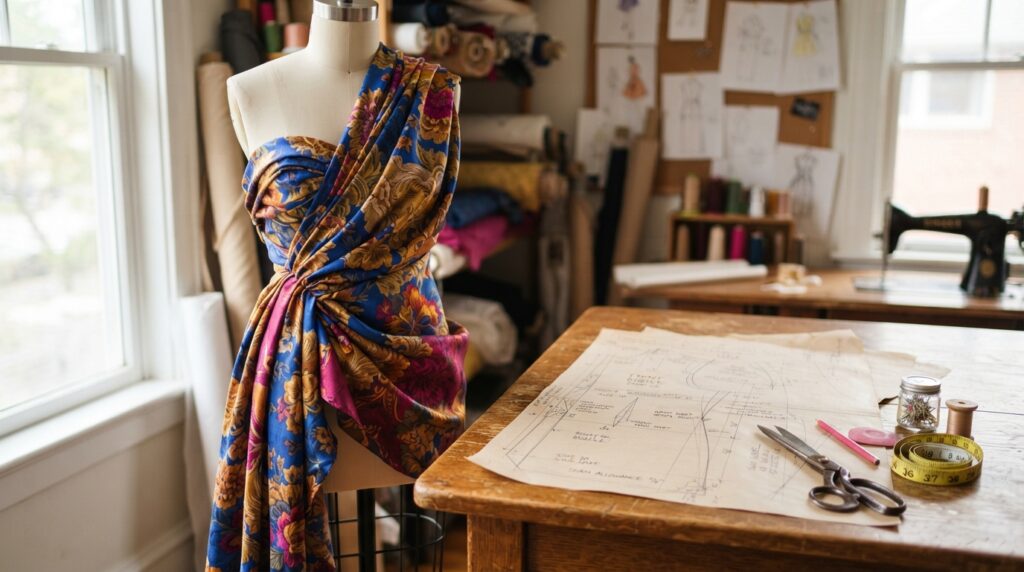
A tailored jacket, a bias-cut gown, and a graded production run can call for different pattern-making methods. Flat drafting starts with measurements, draping begins with fabric on a form, and CAD creates patterns digitally. The best starting point depends on the design task, while the three methods work well together rather than competing.
Each method turns a design into a pattern in a different way. The comparison below shows where each method starts, what work it suits, and its main tradeoff.
| Method | Starting point | Suitable work | Main tradeoff |
|---|---|---|---|
| Flat pattern drafting | Measurements and construction lines | Blocks, tailored garments, consistent production | Needs accurate measurements and careful drafting |
| Draping | Fabric shaped on a dress form | Bias cuts, cowls, and sculptural details | Must transfer marked fabric to pattern paper |
| CAD or digital pattern making | Digital pattern pieces | Editing and grading patterns | Needs suitable software and digital skills |
Flat pattern drafting from measurements
Flat pattern drafting uses body measurements and ease allowances to build pattern lines on paper or in CAD. Designers use this method to create basic blocks and slopers, tailored garments, and production patterns that need consistent sizing. Its measured lines make it useful when a style must be repeated across many garments.
Drafting can also help designers adjust a known pattern shape with control. A new neckline or sleeve can grow from a familiar base, with each change marked on the pattern. This method suits designs that rely on clean lines and planned structure.
Draping and digital pattern making
Draping develops a shape by manipulating fabric directly on a dress form. We mark the fabric, remove it, and transfer its shape to pattern paper, then add seam allowances and pattern markings. It works well for bias-cut garments, cowl necklines, draped details, and asymmetrical designs.
CAD, or computer-aided design, lets us create and adjust pattern pieces on screen. Drafting works well for blocks and steady production, draping suits fabric-led forms, and CAD supports digital edits and grading. Treat a digital garment rendering as a design check, not the sole approval of fit.
What Happens Between a Sketch and a Production Pattern?
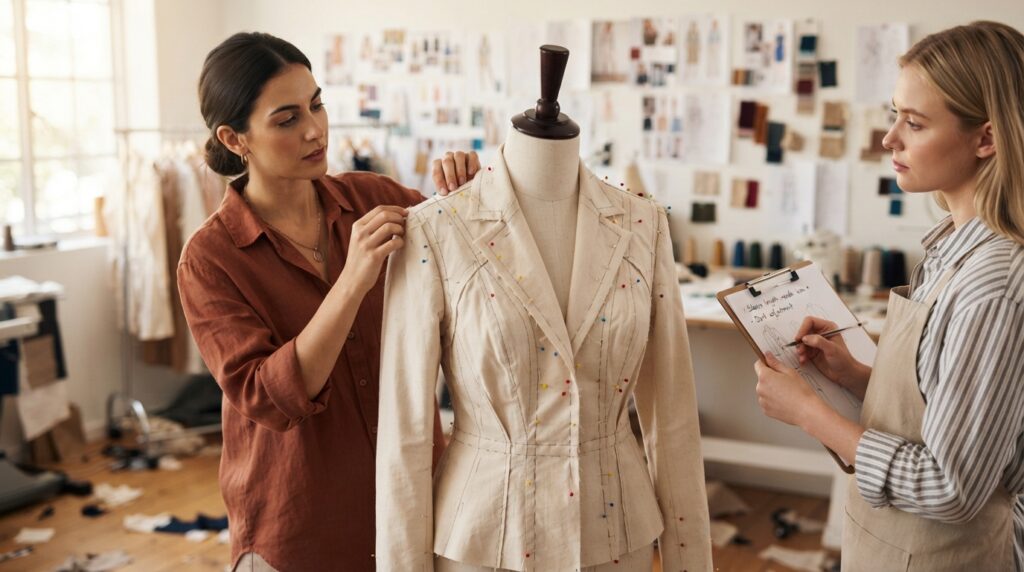
A production pattern should follow a tested sample, not just the first draft made from a sketch. We move from the design and fabric choice to measurements, a first pattern, sample sewing, fitting, and revisions. Testing matters because a line that looks right on paper can behave differently in fabric. A toile is a sample garment used to test fit before production.
Fit prototypes also help us check how a garment sits and moves. Our guide to fashion collection planning covers sample review and production planning.
From design brief to a usable pattern
Start with the design brief and intended fabric. Fabric weight and drape shape how the garment hangs, so they affect pattern choices. Then record the intended body measurements and develop a first pattern that reflects the design.
Cut and sew a toile from fabric with a similar weight and drape to the final material. Fit it on the intended body or a form that matches the design measurements. Make notes on where the garment pulls, hangs, or restricts movement.
Testing a sample and correcting fit
During fitting, check the areas that affect balance and movement. A pattern may look smooth at the front but still pull across the back or restrict the arm. Use specific checks to guide revisions:
- Compare front and back length.
- Check whether the shoulder slope follows the body.
- Review armhole balance as the wearer moves.
- Check ease for reaching, sitting, and walking.
- Confirm that seams match where the pieces join.
Approving a pattern without testing a toile in fabric with suitable weight and drape can lead to a poor production fit. Revise the pattern, sew another sample when needed, and compare it with the intended shape. Record each approved alteration so the production version matches the tested sample.
Which Tools and Software Support Pattern Development?
A French curve and a straight ruler help refine marked fabric after it comes off a dress form. Manual tools support paper drafting and hands-on draping, while software helps edit patterns and preview garments. Each setup serves a different task, and digital previews support decisions before physical sampling.
CAD software can cost $5,000 to more than $50,000. Digital pattern making can cut sample-making costs by up to 30% when teams use digital previews to reduce physical sample rounds.
| Setup | Tools or software | Principal task |
|---|---|---|
| Paper drafting | Pattern paper, straight ruler, French curve | Draw and refine pattern lines |
| Dress-form draping | Dress form, fabric, pins, pattern paper | Shape and mark fabric on a form |
| CAD/3D work | Gerber AccuMark, CLO3D | Edit patterns, grade, make markers, preview garments |
Manual tools for paper and dress-form work
Paper drafting uses rulers and pattern paper to map measurements and lines. A French curve helps shape smooth curves, while a straight ruler keeps long edges clear. For draping, designers also use a dress form, fabric, and pins to hold fabric in place as they shape it.
After marking a draped shape, we transfer it to pattern paper and add the details needed for sewing. The two manual setups share some tools, but their work differs: one draws a pattern, while the other shapes cloth first.
CAD and 3D software in production
Gerber AccuMark offers tools for pattern making, grading, and marker making. CLO3D creates virtual garment visualizations with 3D simulation technology. A digital model can show how a design looks before a team cuts physical fabric.
Those previews help teams decide which changes to make before sampling. Savings of up to 30% in sample-making costs depend on using digital work to reduce physical sampling. Keep each revision clearly labeled so a later fit adjustment can be traced to the right pattern file or paper version.
What Types of Patterns and Sewing Brands Should Designers Know?
Pattern categories describe different things: the system used to develop a pattern is not the same as the shape of its pieces. Standard-size, bespoke, transformation, and digital systems describe ways to develop or use patterns. Piece shape describes whether pattern parts match across a central line. These are separate ways to classify patterns.
A standard-size system uses set size ranges, while bespoke work develops a pattern for one person. Transformation changes an existing pattern into another style, and digital systems use software to build or edit patterns. A designer may use more than one system in a single project.
Pattern-making systems serve different needs
Standard-size patterns support repeatable sizing for groups of customers. Bespoke patterns focus on a particular person’s measurements. Transformation uses changes to an existing pattern to form a different design, while digital pattern making uses computer tools to develop and adjust pieces.
These systems do not tell us whether a pattern piece is symmetrical. That term describes the shape of the piece itself, not the way a designer made it. Keeping the two labels separate makes pattern notes easier to read.
Symmetrical and asymmetrical pattern pieces
Symmetrical pattern pieces have matching parts on both sides of a central axis. Asymmetrical pieces do not match across that line. Jeans, jackets, and T-shirts often use symmetrical patterns, while blouses, skirts, and dresses can use asymmetrical ones.
Asymmetrical patterns can create irregular shapes and complex curves. They take longer to produce and need precise adjustments. A well-made symmetrical pattern can support consistent production, and efficient layout during marking can reduce fabric waste.
The Big Four commercial pattern brands
Simplicity, McCall’s, Vogue, and Butterick are known as the Big Four sewing-pattern brands. In 2025, their business was sold as a going concern for $2.25 million. The sale included the historical and vintage pattern library for all four brands.
After the sale, Simplicity Creative Group planned to keep operating in New York City with about 78 employees. A Vogue Patterns Spring 2026 catalog was offered for $40.00. Those details describe the stated sale and catalog offer, not a ranking of which patterns sewists choose most.
Common garment patterns include jeans, jackets, T-shirts, blouses, skirts, and dresses. Those examples do not show which patterns are most popular. Before buying a vintage pattern, check its envelope for the size range and whether its pieces are complete.
What Skills and Career Facts Matter for New Pattern Makers?
New designers can build a useful foundation by learning measurement-based drafting before adding draping and CAD skills. The U.S. median annual wage for fashion designers was $80,690 in May 2024, but that figure is not a pattern-maker-specific salary. It describes the fashion designer occupation, not pattern makers alone.
Pattern work calls for close attention to measurements, fabric behavior, and how design choices affect production. We can learn those skills in stages, practicing on real garments instead of trying to master every tool at once.
Employment of fashion designers is projected to grow 2 percent from 2024 to 2034. About 2,300 openings are projected each year on average over that decade. This outlook covers fashion designers, not a separate pattern-maker job category.
Build skill by testing one change at a time, then note what the fabric and fit reveal.
- Practice measurements and ease with a basic block.
- Use draping to learn how different fabrics shape a garment.
- Learn digital workflows after building a clear grasp of pattern structure.
- Save pattern versions and notes to show how each fit choice changed the design.
A focused portfolio can show the fit decisions behind finished garments as well as the silhouettes themselves.
Conclusion
We can choose pattern methods more confidently when we start with the garment’s fit and production needs. A structured jacket and a soft, flowing dress may need different approaches, and the designer’s workflow also matters. The goal is a pattern that serves the design and works in the setting where the garment will be made.
Choose one garment from a current project and take its intended measurements. As you develop its foundation pattern, write down the fit choices that shape the result, including where you allow room or change a line. Begin with one garment and one clearly recorded set of measurements, then use what the fit teaches you to guide the next design.