A beautiful label alone cannot tell us how a garment was made or what its production cost the planet and the people who made it. A garment’s supply chain can affect its environmental footprint, animal welfare, labor conditions, and long-term value. We also need to watch for greenwashing, when marketing makes a product seem more responsible than the evidence shows.
Choosing clothing responsibly takes more than recognizing a luxury name. We can weigh design and durability alongside sourcing, production, and transparency. That means looking beyond a polished campaign to the details a brand shares about its work.
This guide offers a practical way to compare claims and choose pieces thoughtfully. We can make a more informed choice by checking evidence, not relying on a sustainability slogan.
Key Takeaways
- Luxury status alone does not prove responsible production.
- Check the scope and date of claims and certifications.
- Compare ratings with the evidence and practices they assess.
- Consider materials, labor, climate impact, and garment longevity.
- Use provenance details to learn where and how a garment was made.
- Choose pieces we expect to care for and wear over time.
What Does Sustainability Mean in Luxury Fashion?
A luxury label is more sustainable when it can show responsible choices across production, materials, transparency and a garment’s life after purchase. Luxury status does not guarantee low impact; resource-heavy materials, packaging, and transport can all add to a product’s footprint.
We should assess four separate areas: ethical production, materials, transparency, and circularity. Ethical production includes safe work and fair treatment. Materials and sourcing tell us what goes into a garment and how those inputs are made.
Assess production, materials, transparency, and a garment’s life after purchase as separate parts of sustainability.
Transparency means the brand shares useful details about its practices and supply chain. Circularity means keeping products and materials in use through repair, resale, reuse, or recycling.
Scope 3 emissions are indirect emissions across a company’s value chain, including the production and transport of goods. Those emissions matter because a garment’s climate impact can extend well beyond a brand’s own offices and stores.
Craft and longevity can reduce the need to replace clothes, but quality alone does not make a product responsible. The London Business School discussion of luxury’s environmental challenges also points to durability, repair, and transparency as ways brands can respond.
We should look for responsible sourcing and production behind claims of craftsmanship. Treat sustainability as a set of separate, checkable practices rather than a single label.
How Can We Verify a Luxury Brand’s Sustainability Claims?
Start by asking what a sustainability claim covers, who verifies it and what evidence a customer can inspect. Scope matters: a claim about one fabric or collection does not prove the same practice applies across a whole brand.
Check the exact claim, its proof, and the part of the business it covers. A practical checklist helps us compare brand statements without mistaking attractive wording for a result.
- Find the product, collection, or business practice covered by the claim.
- Look for named fibers and materials rather than broad terms like “eco-friendly.”
- Check supplier and labor disclosures for useful details about production.
- Look for independent certification, and read what its standard covers.
- Compare measurable targets with a clear deadline against reported results.
Fair Trade USA, the Global Organic Textile Standard (GOTS), and B Corp are examples of third-party certification used to assess ethical fashion claims. Each certificate applies to a defined standard or scope.
A certificate does not automatically cover every item or every part of a company. A target is also not a result: a brand can promise a future change without having achieved it.
One common mistake is treating a “conscious” label as proof of fair labor or low emissions. The word may sound reassuring, but it does not tell us who checked the claim or what they examined.
Dates matter because a supplier, product, or standard can change. Check the scope and date of a certification before treating it as proof about a whole collection.
What Does Stella McCartney Do Differently?
Stella McCartney pairs a long-running animal-free policy with specific restrictions on chemicals and materials. Those rules offer concrete details to assess, though they do not prove every product has low impact.
The brand says its collections contain no leather, feathers, fur, or exotic skins. Its shoes and bags also use no animal-derived glues. Good On You rated Stella McCartney 4/5, “Good,” in May 2024.
Animal-Free Materials and Chemical Restrictions
Stella McCartney says all products have been PVC-free since 2010. The company also says it bans PFCs and azo dyes from its production and supply chain.
It says it does not use denim sandblasting, a process that can cause fatal lung disease in workers. Its Product Restricted Substances List covers direct suppliers, raw materials, components, and packaging materials.
Material innovation is part of the brand’s approach. Mylo is a mycelium-based leather alternative, while Kelsun is made from seaweed.
Wool, Sourcing and Packaging
The brand rejects wool from farms that allow mulesing, a practice involving the removal of skin from sheep. Stella McCartney says it is moving its full wool supply chain toward regeneratively sourced wool.
It also says all paper and packaging it uses comes from recycled sources. That claim gives us a specific sourcing point to check, rather than a broad promise about every part of production.
Circularity and Store Operations
Stella McCartney launched its first consumer-facing take-back and recycling scheme with the Spring 2023 collection. At launch, the scheme included one product designed for disassembly.
New stores have used LED lighting since 2013. The company says those lights use 75% less energy and last over 25 times longer than conventional bulbs.
The Old Bond Street flagship and London head office use 100% renewable energy. These site details are useful, but they do not represent every operation in the brand’s supply chain.
After 10 years, Stella McCartney ended Environmental Profit & Loss reporting. The brand says it is moving toward reporting aligned with the Science Based Targets initiative and other standards, and has set a net-zero emissions target for 2040.
Those plans show ambition, not achieved impact. An animal-free material is not automatically impact-free, so we should still check what it contains and how it is made. A material’s animal-free status is one useful check, but it cannot replace scrutiny of its ingredients and supply chain.
Which Luxury Houses Show Progress on Social and Supply-Chain Practices?
Chloé combines B Corp certification with initiatives intended to make social commitments and garment provenance more visible. Each tool has limits: a certification or digital record can support a claim without proving every detail.
Chloé became a B Corp-certified luxury fashion house in 2021. B Corp certification assesses a company’s social and environmental practices, but it should not be read as a guarantee that every product meets the same standard.
Chloé’s B Corp Status and Reporting
Chloé set a target for 90% of its materials to be lower-impact by 2025. A target sets an aim; it does not confirm that the brand reached it.
Since April 2023, Chloé has operated as a “Société à Mission,” a purpose-driven company status. The house says its focus includes women’s advancement and responsible environmental and social practices.
Digital IDs and Resale
Chloé launched digital IDs for garments in 2025, with supply-chain traceability and resale through a partnership with Vestiaire Collective. A garment’s digital ID can help a buyer inspect its provenance and support its resale.
Provenance is a garment’s documented production history. A digital ID makes information easier to access, but it does not prove that every claim in the record is accurate.
We can use a traceability tool to check specific details about a garment, such as its materials or production. A traceability tool is most useful when it connects to specific, verifiable information about a garment.

How Should We Read Sustainability Ratings?
A brand rating is a useful comparison point, but the date and scope matter as much as the score. Ratings are snapshots, not complete or current verdicts on every practice.
Read a score beside its rating date and description. Good On You’s ratings below show different scores and assessment dates for four fashion labels.
| Brand | Good On You rating | Rating date | Rating description |
|---|---|---|---|
| Stella McCartney | 4/5 | May 2024 | Good |
| Chloé | 3/5 | December 2024 | It’s a start |
| Vivienne Westwood | 2/5 | July 2025 | Not good enough |
| Gabriela Hearst | 2/5 | September 2023 | Not good enough |
The scores reflect assessed evidence and may differ by date and scope. Gabriela Hearst’s September 2023 rating falls outside the two-year window from October 2026, so we should not present it as recent.
Brand posts and public statements can explain a company’s own claims, but they are not substitutes for independent evaluation. A label may share a target while a rating weighs a wider set of practices.
Use ratings to guide further checks, not to settle every question about a brand. Check the rating date before using a score to compare brands today.
Which Labels Build Sustainability Into Design and Sourcing?
These labels offer different ways to make sustainability visible, from reused textiles to garment-level provenance. Their approaches differ, so we can compare the evidence each brand provides.
Marine Serre centers upcycling, Another Tomorrow tracks garment provenance, and BITE Studios focuses on material choices. Each approach gives us a distinct starting point for checking impact.
Upcycling in Marine Serre
Marine Serre says around 50% of its collections are made from upcycled materials. Upcycling uses existing textiles again, which can make use of fabric already in circulation.
The remaining collections use recycled and other sustainably sourced materials. That distinction matters: the brand does not say that all of the remainder is recycled.
Traceability at Another Tomorrow
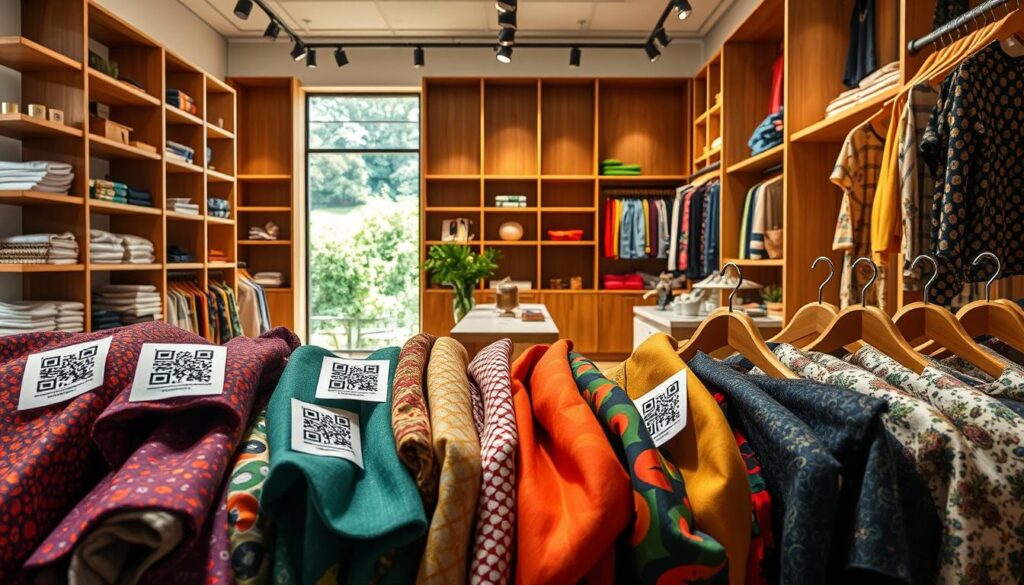
Another Tomorrow garments have QR codes in their care labels that link to digital IDs. Those records reveal provenance, material sourcing, and production information.
The brand prioritizes organic cotton, hemp, ethical wool, and FSC-certified viscose. It says it avoids conventional cellulosic fiber, viscose and cotton, down, and polyester.
Another Tomorrow also operates a resale program. The program gives garments another route to use, while the digital record helps buyers inspect where and how an item was made.
Lower-Impact Materials at BITE Studios
BITE Studios prioritizes organic cotton, responsible or organic wool, and forest-friendly viscose. It avoids conventional cotton, animal skins, fur, feathers, virgin polyester, polyamide, and elastane.
The brand also manufactures closer to home. That choice may help reduce transport distances, though it does not tell us the full impact of a garment’s materials or production.
| Brand | Distinct approach | Concrete example |
|---|---|---|
| Marine Serre | Upcycling | Around 50% of collections use upcycled materials |
| Another Tomorrow | Provenance and resale | Care-label QR codes reveal garment production details |
| BITE Studios | Material selection | Avoids virgin polyester, polyamide, and elastane |
A preferred fiber or a digital record is only one part of assessing overall impact. Compare what each label can document, not just the material names it promotes.
Is Zara Ethical Now, and What Does Its Scale Mean?
Zara’s record is mixed: it has reported some operational improvements, but its scale and external ethical assessments remain significant concerns. One score cannot tell the whole story about its production, climate impact, or labor practices.
Good On You rated Zara “It’s a Start” overall in January 2026, while The Good Shopping Guide gives it a poor score. The latter says Zara has not met its 70/100 fashion-category benchmark.
The Good Shopping Guide marks Zara poorly for human rights and its Human Rights+ criteria. It also notes that Inditex participates in the Ethical Trading Initiative and publishes a Modern Slavery policy.
- Production volume: Zara makes over 450 million garments each year, and design-to-distribution can take as little as 15 days.
- Emissions: Inditex reported 13,920,988 tons CO2e in 2024, while transport emissions rose 10% that year.
- Water and energy: Zara’s dyeing and washing water efficiency improved 26% compared with 2020; Inditex aims for 100% renewable energy at its facilities by 2030.
- Join Life: The collection is a small share of production, while 99% of production follows conventional processes.
Transport and distribution account for about 20% of Zara’s total climate footprint. Inditex reduced Scope 3 emissions by 1% since 2018, against a 51% reduction target by 2030.
The 2026 analysis describes a 30% emissions-reduction commitment by 2030 and carbon neutrality by 2040, with targets approved by the Science Based Targets initiative. Its environmental-metrics table also lists a 50% emissions-reduction pledge by 2030 for Inditex.
Those 30%, 50%, and 51% figures are different reported figures. We should not treat them as interchangeable targets, especially when baselines and scopes may differ.
Zara’s record includes stated improvements alongside huge production scale, conventional processes, and human-rights concerns. Compare a target with measured progress and its stated baseline before treating it as evidence of a reduced footprint.
Which Materials and Garment Practices Matter Most?
The fiber name is only a starting point: production, processing, use and disposal all shape a garment’s impact. There is no single best fiber for every product or use.
Check the full fabric composition and how the garment will hold up in daily use. A material label alone does not show how a garment was grown, made, dyed, or shipped.
Fiber Choices and Their Trade-Offs
Polyester production yields about two to three times the carbon emissions of cotton production. Washing polyester also releases non-biodegradable microfibers.
Recycled materials or lower-impact inputs may change that picture, but the full production chain still matters. Organic cotton also needs scrutiny because cultivation, processing, and dyeing shape its impact.
Newer alternatives include MIRUM, a plastic-free leather alternative, and Kelsun, a seaweed-based material. These names are a starting point, not proof of low impact; we should check their full composition and production.
A natural fiber is not automatically low-impact. How it is grown, processed, and dyed can affect its footprint.
Construction, Care and Longevity
Good construction can help clothes last longer, especially when seams and closures can handle regular wear. We can check stitching for loose threads and look for sturdy buttons, zippers, and hems before buying.
Repair options matter too. A replaceable button or a seam that can be mended may extend a garment’s useful life, while hard-to-fix details can make routine damage more costly.
Care affects longevity: a garment that needs delicate handling may not suit how we live or do laundry. Consider whether we will wear it often and can follow its care instructions.
Before buying, check the fabric composition and whether the garment can be cared for and repaired over time.
Which Sustainable Luxury Fashion Brands Fit Different Priorities?
The strongest choice depends on which evidence matters most to us, such as deadstock use, preferred materials or traceability. A shortlist is a starting point, not a universal ranking of fashion brands.
Gabriela Hearst and Acne Studios offer examples tied to existing textiles, while Vivienne Westwood and Gucci show different material and traceability goals. Each example calls for a different check.
For Deadstock and Reworked Design
Gabriela Hearst used 30% deadstock fabrics in its 2017 runway collection. Deadstock means unused fabric left from earlier production, and using it can put existing material to work.
Acne Studios launched its Repurposed line in 2020, using discarded offcuts and recycled fabrics. We can check whether a specific item uses these materials or belongs to a broader collection.
For Material and Traceability Goals
Around 90% of Vivienne Westwood’s ready-to-wear collections are made from preferred materials. The figure points to a material goal, but we still need to learn what the brand counts as preferred.
Gucci set an objective for 95% of raw materials to be traceable and launched Gucci Off the Grid in June 2020. The traceability objective is a target, not proof that the brand achieved it.
Familiar or famous labels are not automatically the strongest choice for every concern. We should compare evidence on materials, labor, climate, and transparency for the garment we want.
| Brand | Priority | Specific example | Reader check |
|---|---|---|---|
| Gabriela Hearst | Deadstock fabric | 30% of 2017 runway fabrics were deadstock | Check the fabric used in the item |
| Acne Studios | Reworked textiles | Repurposed line launched in 2020 | Look for offcuts or recycled fabric |
| Vivienne Westwood | Preferred materials | Around 90% of ready-to-wear uses them | Check what “preferred” includes |
| Gucci | Traceability | 95% raw-material traceability objective | Check progress against the target |
Use a shortlist to narrow the search, then verify the specific garment and the scope of each claim.
How Can We Buy Sustainable Luxury Fashion More Affordably?
A more accessible choice can come from buying fewer, longer-lasting pieces or choosing a label with a clear price range and provenance. Price is only one part of the value we get from clothing.
Pre-owned clothing, repairable construction, and a clear record of production can make a purchase go further. KAHINDO says its handcrafted clothing costs $55-$280, is designed in New York, and is made by female artisans in Kenya.
- Choose fewer pieces that suit our regular needs.
- Compare pre-owned options before buying new.
- Check whether seams, closures, and fabric can be repaired.
- Read provenance details about who made the garment.
Each KAHINDO handcrafted piece includes a provenance card documenting the artisan and labor hours. KAHINDO is one example, not proof that all ethical luxury clothing falls within this price range.
Price alone does not show lasting value; construction, care, and provenance matter too.
Check the garment’s construction, care needs and provenance before deciding whether its price represents lasting value.
Conclusion
The most useful choice is the one whose materials, production and expected use fit the standards we care about. No label excels at every measure, so a specific claim helps most when its scope, evidence, and timeframe are clear.
Before buying, inspect the product’s material composition and the brand’s labor or provenance information. Then ask whether we can wear and care for the piece over time.
Before our next purchase, we can check one garment’s composition and provenance and choose the piece we expect to wear longest.