
A fashion collection can average 12-20 pieces, yet a startup can begin with just three to five garments. A sellable collection starts with a clear customer and a plan that connects design decisions to production and retail realities.
Designers and brands building a first line or planning a new season face the same challenge: creative ideas must meet customer demand, fit the business, and arrive on time. Our process helps us make those links before small choices turn into costly problems.
We will shape the work through customer research, design direction, assortment planning, product development, production, and review. Each step gives us a way to test creative choices against the market, target price, and business needs.
We can make better decisions at every stage when we define the customer, the collection’s purpose, and the limits before we sketch.
Key Takeaways
- Start with a specific customer and a clear collection purpose.
- Keep the first assortment small enough to manage well.
- Connect design choices to costs, production needs, and delivery dates.
- Document each style so teams can develop and make it correctly.
- Review sales and customer feedback before planning the next buy.
What Is a Fashion Collection, and How Is It Structured?
A fashion collection is a coordinated group of garments designed to work together and serve a defined customer. Connected pieces share a point of view, such as a color palette, use, or season, rather than forming an unrelated set.
A style is a version of a garment design distinguished by details such as color, fabric, or print. A round-neck T-shirt in four colors counts as four styles, even though all four belong to one garment category.
A collection brings related garments together, while each distinct design version counts as a style.
An SKU, or stock keeping unit, identifies one unique saleable inventory unit. A T-shirt style in two colors and three sizes may have six SKUs, since each color-and-size combination needs its own inventory record.
Collections commonly average 12-20 pieces, but that figure is a broad reference, not a minimum. A manageable startup collection can begin with three to five garments, which limits the number of designs and production decisions.
Fashion collection examples are most useful when we look for how pieces work together, not just how many designs appear. A jacket, top, and skirt might share a fabric or color story while serving different needs in one customer’s wardrobe.
For a first launch, a tightly edited set of three to five garments can be a more manageable starting point than a broad assortment.
How Do We Define the Customer, Brand, and Collection Concept?
A useful collection brief names the person we are designing for before it describes the clothes. Specific details about the customer help us turn a broad idea into useful design choices.
A focused customer profile gives every style a clear test: does it suit the person’s daily life, needs, and budget? That question can guide the target price, fit, and product mix.
Build a usable customer profile
Record the customer’s age range, lifestyle, work or daily context, clothing needs, price sensitivity, and likely purchase objections. We might learn that a customer wants office-ready clothes but avoids dry-clean-only items or stiff fabrics.
Short interviews can reveal needs that sales figures cannot explain. We can ask:
- Where and when would you wear this garment?
- What fit details make clothes comfortable for you?
- What price feels reasonable for this kind of piece?
- What clothing item can you not find in stores?
Daily routines, comfort, budget, and personal taste all shape clothing needs. Our guide to personal style and wardrobe needs offers useful context for thinking about how clothes fit into a customer’s life.
Turn brand identity into a collection story
Connect brand values, season, product type, target price position, and a clear narrative in one collection story. Ideas for a fashion collection theme can start with a place, period, artwork, emotion, or lifestyle.
One concept focused on professional women ages 25-35 and developed seven looks into 16 outfits. That example shows how a story can guide combinations; it is not a required ratio or industry benchmark.
Names for a fashion collection should describe its intended story and stay distinct from the business name. Before finalizing a clothing-store name, check domain and social-media availability, then search trademarks.
A focused customer profile gives us a test for every later decision, from price point to silhouette.
How Do We Turn Trend Research Into a Cohesive Design Direction?
Trend research is useful when it helps us make a sharper choice for our customer, not when it adds more references to the mood board. Evidence from past sales and customer comments can keep inspiration grounded.
Forecasts can inform design choices, but they cannot prove what a particular customer will buy. We should compare them with actual demand before building a collection around a trend.
Separate lasting customer signals from short-lived trends
Start with past sales, returns, customer feedback, and questions from buyers. Then compare those signals with runway looks, street observations, and fashion forecasts.
A customer who repeatedly asks for easy-care work clothes may value that need more than a striking runway detail. A forecast can give designers new options, but customer behavior helps us judge their fit.
WGSN offers fashion design forecasts for 2026-2028, with guidance on colors, materials, prints, and graphics by category. We can use that information as one input, rather than a fixed design order.
Translate a theme into design decisions
Turn the theme into a mood board, a short palette, a silhouette direction, and a shortlist of design details. Ideas for a fashion collection theme may come from a customer’s lifestyle, a place, an era, or an emotion.
For Fall 2026, trend directions included moodier florals, oversized proportions, cropped styles, cocoon-like tailoring, Art Deco details, and softened suiting. A brand might select floral brocade, a geometric detail, and softer suiting, then leave out the rest.
Each selected color, fabric, and shape should suit the brand’s customer and product type. A trend that clashes with the intended price or daily use does not earn a place just because it is current.
Keep a short record of why each trend made the cut so the collection’s design choices remain intentional.
How Do Fashion Collection Planning Strategies Build a Balanced Range?
A balanced range gives every style a clear role, so the collection can feel distinctive without becoming hard to sell or produce. Role matters: each garment should serve a customer need or express the brand.
Use a mix of hero pieces, reliable commercial items, and classics or carryover styles. A range plan records those creative choices alongside prices and quantities before development begins.
Balance commercial styles, classics, and hero pieces
Hero pieces give a fashion collection a distinct point of view, such as a statement coat or a printed dress. Commercial styles meet familiar customer needs and can support steady sales across the range.
Classics and carryover styles can return in new colors or fabrics. A useful range might pair one unusual jacket with everyday trousers and a shirt that can be reordered in another color.
Assortment planning balances variety across product categories and styles with variation across brands, colors, and sizes. We can use sales history and customer fit, along with brand identity, rather than letting trends alone set the mix.
Build the range plan before locking quantities
A fashion collection planning strategies template should capture both creative and commercial choices. Examples of fashion collection planning strategies should show how concept, category, materials, price targets, and quantities connect.
Record category, season or collection name, styles, sketches, materials, colors, sizes, retail price, cost price, target and actual margins, and order quantity. The sample entries below show how fields can guide decisions.
| Field | Concrete example | Planning use |
|---|---|---|
| Season and collection name | Fall/Winter, Urban After Dark | Keep the range tied to one season and story |
| Styles and outfits | 7 looks, 16 outfits | Check how pieces combine for customers |
| Material and color | Silk crepe, beige | Link fabric and color to a planned style |
| Material and color | Cotton drill, rusty blue | Track a second fabric and color choice |
Fill in costs and prices before agreeing on quantities. The best fashion collection planning strategies check that each planned style contributes to the customer offer before approving its place in the range.
How Do We Choose Fabrics and Colors Without Overcomplicating the Line?
A fabric is right for a design only when its look, performance, availability, and cost work for the intended customer. Fit for purpose matters more than a material’s appeal on a swatch card.
Check weight, drape, durability, care, supply, and cost before approving fabrics. These factors affect how a garment wears, how it looks, and whether the brand can make it on time.
Breathable cotton and linen often suit Spring/Summer designs. Fall/Winter garments often use warmer wool, tweed, or velvet, though a fabric still needs to match the garment’s use and price.
A Fall/Winter concept can combine silk crepe, cotton drill, wool jersey, and waterproof fabric. Each material adds a different function, while a shared palette can keep the designs connected.
Before fabric approval, check:
- Hand feel against the customer’s comfort needs.
- Weight and drape against the garment’s intended shape.
- Care needs against the customer’s likely routine.
- Color consistency across sample and bulk fabric.
- Supplier availability for the planned order and timing.
A simple palette can give each color a role: base, supporting, or accent. This is a rule of thumb, not a fixed formula; a small collection may need fewer colors.
Keep the palette and material list small enough that styles can share fabrics without losing their individual purpose.
What Should Each Style’s Technical File Include?
A garment specification needs enough detail that a production partner can make the intended piece without guessing. Clear records help pattern makers, factories, and buyers understand the same design.
Each style needs one complete, current set of construction and product details. A missing measurement or unclear seam instruction can lead to errors in fit or production.
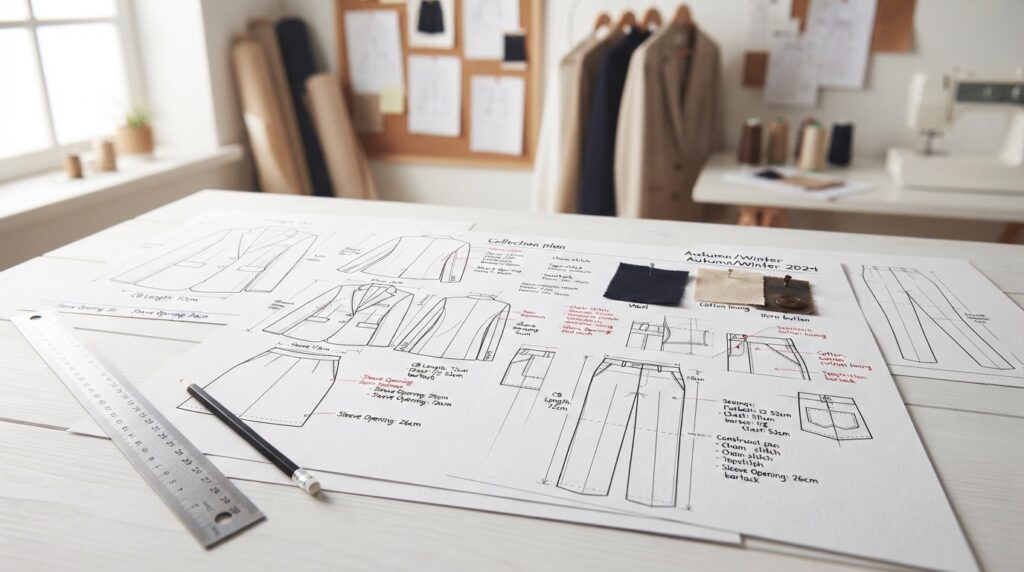
Record construction details in the tech pack
A tech pack is a technical file for developing and making a garment. Include front and back flat sketches, measurements, materials, trims, stitching or construction notes, and size tables.
Use clear notes for details such as seam placement, closures, and finish. Label each revision with a version and date, so the factory does not use an older measurement table by mistake.
Technical files can also include manufacturing instructions. A complete garment specification brings sketches, measurements, materials and trims, construction details, and size information into one working record.
Prepare a line sheet for buyers and sales
A line sheet is a sales-facing tool, not a factory instruction file. It helps buyers review the offer and compare styles, prices, colors, and delivery details.
List the style number, product description, colors, available sizes, and delivery details. Add wholesale and recommended retail prices when those figures apply to the sales channel.
A line sheet might describe a cropped jacket in two colors, while the tech pack explains its measurements, seams, and trim. Keeping the jobs separate makes both files easier to use.
Keep one approved file version linked to each style number so revisions do not get lost between teams.
How Do We Set Costs, Retail Prices, and Margin Targets?
A profitable price starts with the full cost of making and selling a garment, then works backward from the margin we need. Full cost includes more than the factory unit cost.
Gross margin is the share of sales revenue left after unit cost, while markup compares price with cost. A $30 garment cost priced at $100 yields a 70% gross margin before other costs.
For example, a $30 unit cost and $100 retail price leave $70 before other expenses. That is a 70% gross margin, while the markup on cost is different because it compares the $70 gain with $30.
Consider fabric, labor, packaging, freight, marketing, and other costs before deciding whether a retail price works. Channels, discounts, returns, and overhead can change the price a brand needs for profit.
The table shows arithmetic examples for a $30 unit cost. These are not recommended targets for every brand.
| Gross-margin target | $30 unit-cost example | Calculated retail price |
|---|---|---|
| 50% | $30 cost is half the price | $60 |
| 60% | $30 cost is 40% of price | $75 |
| 70% | $30 cost is 30% of price | $100 |
A merchandise planner can compare total range cost and total retail value with the target margin. After sales and discounts, actual intake margin shows what the business earned from the goods sold.
Compare total range cost and retail value with the actual intake margin before approving the buy.
How Do We Build a Seasonal Calendar and Critical Path?
A collection calendar should be built backward from the date products need to reach stores or customers. Start with delivery, then assign dates for the work that must happen first.
Assortment planning often happens at least six months before a season begins. The critical path is the schedule’s longest chain of dependent tasks, where one delay can push later work and final delivery.
Work backward from delivery and launch dates
Begin with the intended in-store or online delivery date. Work back through sales materials, samples, purchase orders, fabric and trim sourcing, production, and shipping.
Many brands plan two to four collections around seasonal calendars. Spring/Summer deliveries usually arrive from January through March or April, while Fall/Winter deliveries usually arrive from July through September.
Build time for each handoff, not just the factory run. If sales materials depend on finished samples, those samples need approval before the sales team can meet its deadline.
Track dependent tasks and protect buffer time
A critical path links tasks, milestones, dependencies, and lead times to a timeline. Regular updates and clear communication help teams spot a delay before it moves through the schedule.
Track these five milestones:
- Concept approval.
- Material confirmation.
- Sample approval.
- Production start.
- Delivery.
Fabric lead times, test results, factory capacity, and shipping conditions can change. Review the schedule often and adjust dependent tasks when a supplier date or test result moves.
Protect buffer time for supplier delays, holidays, and shipping. A calendar with no room for change can turn a small delay into a missed delivery.
Add buffer time to the tasks most exposed to supplier, holiday, and shipping delays.
How Do We Develop and Approve Samples?
Sampling is the checkpoint where we find out whether a design works as a real garment, not just as a sketch. Fit sessions show how the piece sits and moves on a fit model.
Compare every sample with its measurements and construction notes before approving changes. Revise the pattern or garment details when fit, fabric behavior, or workmanship misses the intended result.
Review each sample for:
- Fit and movement during sitting, reaching, and walking.
- Fabric behavior in the intended garment shape.
- Measurements against the size specification.
- Stitching and closures for function and strength.
- Finish consistency across seams and garment details.
A first fit prototype tests how a garment sits and moves. A second prototype may follow when the first reveals changes that need another round of testing.
A sales sample shows the design to buyers or customers and is ideally ready at least one month before a sales fair. A pre-production sample guides bulk production and should match the approved construction.
Fit approval should not rely on appearance alone. Compare the sample with the intended measurements, notes, and use before giving the factory permission to proceed.
Approve the final sample only after its construction and measurements match the production specification.
How Do We Plan Production, Quality, and Compliance?
Production planning needs both a realistic factory schedule and a quality standard that can be checked against the approved sample. Written checks give each team a shared way to judge the work.
Set inspection points for incoming materials, work in progress, and finished garments. Production commonly takes two to three months after orders are placed, though order size and work needs affect timing.
Coordinate factories, costs, and quality checks
Factories may set minimum order quantities. Order size, materials, labor, and required operations affect production cost and lead time.
Smaller runs may take at least four weeks, while larger runs may take about six weeks. These figures describe production timing, not the full time needed for sourcing and shipping.
Check incoming fabric and trims against approved materials. Inspect work during production, then review finished garments for fit, stitching, closures, and finish.
Check the U.S. rules that apply to the brand
California SB 253 covers companies with more than $1 billion in annual revenue doing business in California. It requires Scope 1 and Scope 2 emissions reporting in 2026, then Scope 3 reporting from 2027.
California SB 707 covers producers of certain apparel and textile articles based on market access. It excludes companies with less than $1 million in annual global turnover and sellers that sell only secondhand goods.
SB 707 implementing regulations are expected no earlier than July 2028. Penalties can reach $10,000 per day, or $50,000 per day for intentional or knowing violations.
The UFLPA creates a presumption against covered imports made wholly or partly in Xinjiang, or by an entity on its Entity List. Rebuttal requires clear and convincing evidence that no forced labor was involved.
The New York Fashion Act remains a proposal in committee, not an enacted law. Keep these records organized:
- Supplier and material origin information.
- Emissions data.
- Producer-responsibility documentation.
- Inspection records.
Rules depend on the company and products involved. Check obligations with qualified counsel or the relevant authority before setting a production plan.
Confirm which reporting and producer-responsibility rules apply to the company before committing to a production and delivery plan.
How Do We Allocate Stock Across Stores and Channels?
A good allocation puts the right depth of styles, sizes, and colors where customers are most likely to buy them. Local demand matters because stores and sales channels do not serve identical customers.
Use store performance, space, location, and channel needs to shape each assortment. OTB, or open-to-buy, tracks the seasonal budget still available for purchases.
Build assortments around store and channel performance
Review sales by store, available space, geographic location, and channel. A small shop may need fewer colors than a large store, while an online channel can show a wider range.
Store clustering groups locations, often by size and sales volume, so similar stores can receive similar assortments. We can then adjust styles, sizes, and colors for each cluster’s performance.
Assortment planning aims to put suitable products in the right channels. A warm-weather location may need a different depth of seasonal fabric than a colder market.
Use OTB to control the buying budget
The OTB formula is Sales + Opening Stock – Closing Stock. The budget changes as sales and stock levels change, showing how much remains for new purchases.
At the start of a season, all stock budget is OTB if no orders have been placed. One example divides $20 million across 200,000 units and 2,000 products, or 100 units per product at a $100 average retail price.
Where the business model allows, a common approach commits about 60% before the season and holds 40% for in-season trading.
| Buying period | Share of OTB | Amount from $20 million |
|---|---|---|
| Preseason | 60% | $12 million |
| In-season reserve | 40% | $8 million |
| Total | 100% | $20 million |
Review OTB every couple of weeks to check spending and remaining allocation. Sales, stock, and delivery needs can all change the next buying decision.
Review remaining OTB every couple of weeks and adjust future allocations to actual store and channel performance.
How Do We Launch, Track Sales, and Improve the Next Collection?
A launch works best when the product story and sales materials are ready before customers encounter the collection. Clear product details help shoppers and buyers understand what each garment offers.
Coordinate launch timing across wholesale and direct-to-consumer channels. Lookbooks, product photography, descriptions, online merchandising, and buyer materials should all show the same product information.
Ready sales materials and clear product details make it easier for customers to understand the collection.
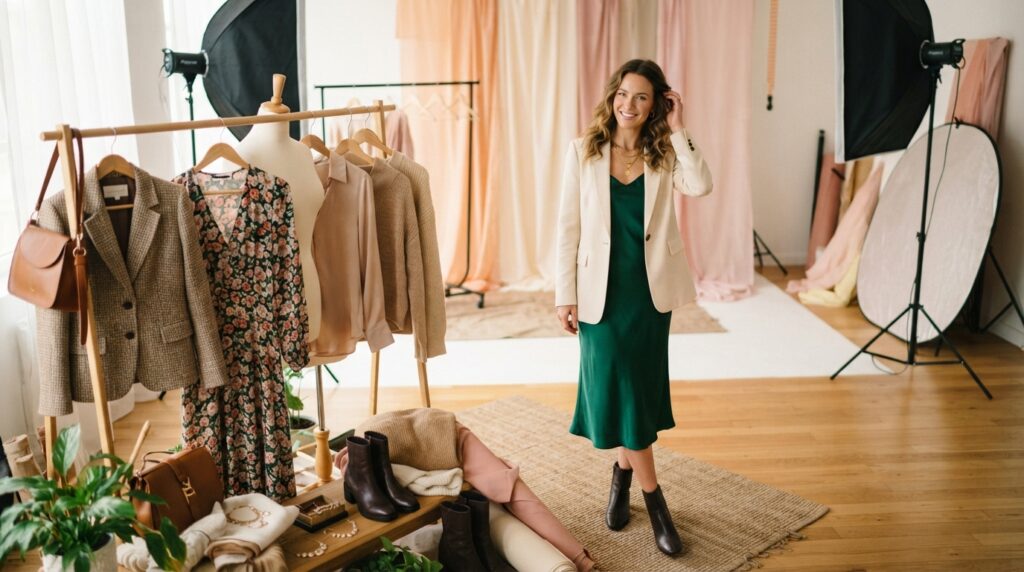
Some brands deliver a collection in two drops per season. Traditional retailers and larger fashion brands may receive new merchandise once or twice a month.
After launch, track sell-through by style, color, and size. A dress that sells well in one color but stalls in another may need a color change rather than a full redesign.
Pair sales results with retailer and customer feedback. Reorder styles that meet demand, revise details that cause problems, and discontinue pieces that do not earn a place.
Record which styles sold through, which sizes lagged, and what customers said before planning the next buy.
Conclusion
A well-planned collection turns a clear creative point of view into products the customer can understand and the business can deliver. Strong planning balances a customer story with a buildable, priced, and deliverable range.
Our next step can be simple: draft a one-page brief naming the customer, season, concept, product scope, target price position, and launch date. That page gives us a clear test for early design ideas and keeps the work tied to real business needs.
Start the next collection by writing that one-page brief and checking every early design idea against it.