
Each year, the fashion industry makes 100 billion new garments, so clear design choices affect a vast number of clothes. A garment can feel balanced, striking, or confusing before we notice its individual details. As new creators, we can learn to make apparel with purpose by seeing how visual choices work together. Visual weight is the apparent pull an element creates in a design because of its size, color, texture, or placement. A large dark patch may draw the eye more than a small pale seam. That pull can shift when we move the patch or change its texture. Our eye responds to these choices before we name them. Learning to notice that response gives us a practical way to shape an idea. We can use the process to make intentional garments, even when we are just starting out. We can begin by identifying what the eye notices first and what holds the design together.
Key Takeaways
- Visual choices shape how a garment reads.
- Line, color, shape, texture, and space act as design materials.
- Principles help organize a garment’s parts.
- A clear focal point can guide the eye.
- Sketching and testing help us refine a design.
- Repair and reuse can keep clothes in use longer.
What Are the Five Elements of Fashion Design?
A seam, a color choice, a fabric surface, and the empty area around a detail all contribute to a garment’s visual language. Five elements give us a useful set of materials to work with: Line, Color, Shape, Texture, and Space. Element lists can differ across design systems, so this guide follows the five-element framework used by IIFT Bangalore.
Some lists count pattern or form differently. That difference does not make one list universal. It means we should check how each design system uses its terms.
Shape is a two-dimensional outline, while form is the garment’s three-dimensional volume.
How line, shape, and form guide a silhouette
Line appears in seams, darts, pleats, and hemlines. Vertical lines can suggest height or elongation. Horizontal lines can suggest width or stability. Curved lines can suggest softness or movement, while diagonal lines can add energy.
Shape is the garment’s two-dimensional outline, also called its silhouette. A boxy jacket and a narrow skirt have different shapes, even before we add details. Form describes the garment’s three-dimensional volume as it sits around the body.
Using shape and form as interchangeable terms is a common mistake. A flat sketch can show shape, but a fitting test helps us understand form. The difference matters when we choose fabric or adjust a pattern.
How color, texture, and space shape what we see
Color has three dimensions: hue, value, and intensity. Hue names the color, such as blue or red. Value describes how light or dark it is, while intensity describes its brightness or dullness.
Texture can be tactile or visual. We feel tactile texture through touch, as with a rough wool fabric. We see visual texture, such as a printed pattern that looks woven but feels smooth.
Space is the area around and between design details. A plain area beside a bold collar gives the collar room to read. Before adding decoration, check whether the silhouette and the space around its details already communicate the intended look.
What Are the Fashion Design Principles?
We can organize the elements with five principles: balance, proportion, rhythm, emphasis, and unity. These principles help us guide the eye and shape a garment’s visual order. We can use more than one principle in a single garment.
https://www.youtube.com/watch?v=94LRlxHiznw
A useful fashion design principles list includes those five ideas. Principles design how we arrange the visual parts, not which materials we must choose. The same elements can create very different results when we change their placement.
Balance, proportion, and scale organize the parts
Balance describes how we distribute visual weight across a garment. Symmetrical balance uses nearly identical sides, such as a centered zipper on a jacket. The two halves feel alike.
Asymmetrical balance uses unequal details whose visual weight still feels steady. A large pocket on one side may balance a group of smaller details elsewhere. The sides differ, but neither feels overloaded.
Proportion describes the size relationship between garment parts and the whole. For example, we can compare a jacket’s sleeve length with its body length. A sleeve that looks too large may change how the whole jacket reads.
Scale describes the size relationship of design elements to the wearer. A tiny print can look quiet on a person, while an oversized motif can draw attention. Proportion compares parts of the garment; scale compares details with the wearer.
These terms are related, but they answer different questions. We can use proportion to judge a collar against a coat and scale to judge that collar against the person wearing it.
Emphasis, rhythm, and unity guide the eye
Emphasis gives a design a focal point, or center of interest. A bright pocket or an unusual neckline can draw the eye first. Without a clear focal point, details may compete for attention.
Rhythm creates visual flow through recurrence or movement. Repeated buttons can lead the eye down a shirt. Curved seams can guide it across the body.
Unity means the garment’s parts work together. When the colors, shapes, and details feel related, we can call the result harmony. Unity does not mean every part must match exactly.
A fashion design principles list answers the question of how we can arrange visual choices. Balance, proportion, rhythm, emphasis, and unity each help us make a different check. A single garment may use all five.
In practice, we can judge balance while sketching and unity after adding details. We can check proportion before choosing a fabric, then use emphasis to place the strongest feature.
When details compete, reduce or reposition them until the garment has one clear visual order.
How Do We Apply the Principles to a Garment?
A contrasting necktie gives us a simple way to see how one design choice can direct attention. One bright tie can become the focal point against a plain dress shirt. Emphasis works best when other details support that focal point.
We can test similar choices in a sketch. The Golden Ratio, about 1:1.618, is one possible proportion reference, not a required formula. We can use it as a prompt for comparing parts, then adjust the design to suit its purpose.
| Garment situation | Design choice | Principle used | Likely visual effect |
|---|---|---|---|
| Bright tie against shirt | Use a strong color contrast | Emphasis | The eye goes to the tie |
| One-sided detail | Balance its visual weight elsewhere | Asymmetrical balance | Unequal sides still feel stable |
| Pleats or buttons | Repeat details at regular intervals | Rhythm | The eye moves along the garment |
No two colors are always wrong together. A pairing depends on the colors’ value, intensity, placement, and intended effect. Black and navy may feel quiet together, while a bright orange beside navy can create stronger contrast.
We can use an uneven detail without making the garment feel off balance. A large shoulder tab might feel steady when a dark cuff or pocket adds visual weight elsewhere. Placement matters as much as size.
Several competing focal points can weaken emphasis and disrupt unity. In a sketch, mark the first focal point and check that the remaining details support it rather than compete with it.
Which Fashion Rules Help Us Build a Useful Wardrobe?
A small set of coordinating clothes can make outfit choices easier without limiting every design decision. Two simple rules can help us plan combinations, while a wardrobe rule of thumb can guide the mix. These are styling tools, not design laws.
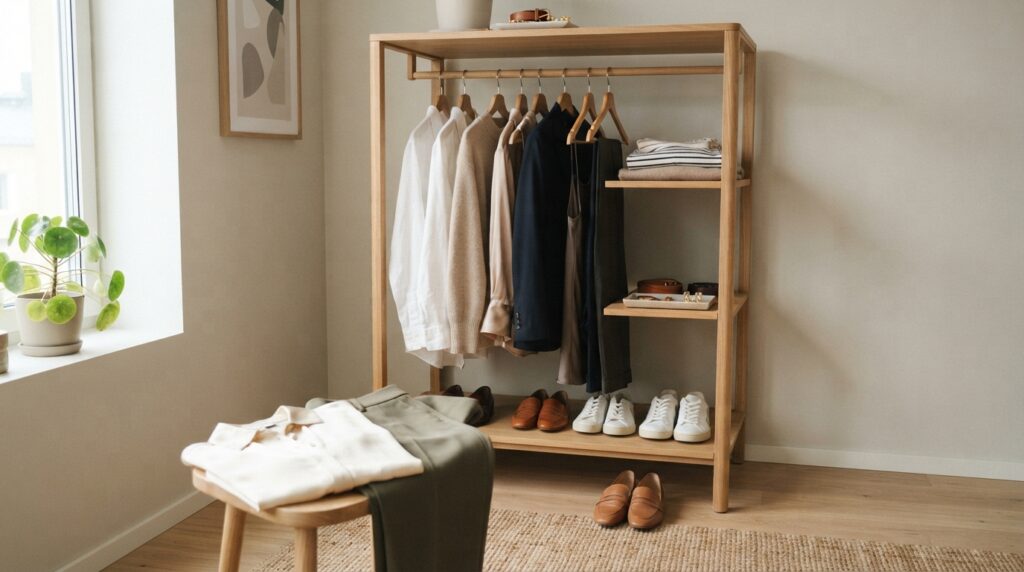
The 3-3-3 Fashion Rule starts with three tops, three bottoms, and three pairs of shoes. One sample set includes a white shirt, black T-shirt, lightweight sweater, jeans, trousers, and a midi skirt.
- Three tops: white shirt, black T-shirt, lightweight sweater
- Three bottoms: jeans, trousers, midi skirt
- Three pairs of shoes: sneakers, ankle boots, flats
Each piece should coordinate with several others, so we can build more than one outfit. For help using clothes we already own, we can explore wardrobe support and closet edits.
The 7-point rule gives basics one point and statement or personality pieces two points. A commonly suggested outfit score is 7 or 8, though some versions allow 6 to 10. ELLE’s seven-point outfit example totals eight with kick flares, a tank top, ballet flats, mesh socks, a suede blazer, a floral headscarf, and sunglasses.
That score is a styling benchmark, not a measure of whether an outfit looks good. The rule of five is not one standardized fashion-design principle. We should clarify which styling version someone means rather than treat one version as universal.
As a wardrobe rule of thumb, we can aim for about 80% versatile staples and 20% expressive pieces. We can change that ratio based on how often we wear statement items. Treat a score or wardrobe ratio as a starting point, then keep the pieces that suit the wearer’s real routines.
What Are the Seven Rs of Sustainable Fashion?
Sustainable fashion choices can start with using existing clothes longer and buying more selectively. The seven Rs offer practical actions for how we use garments and materials. Repair and reuse can extend a garment’s use before recycling becomes the next option.
The seven Rs are Reduce, Reuse, Repurpose, Repair, Resell, Rent, and Recycle. The first four focus on using less and keeping garments in use.
- Reduce
- Reuse
- Repurpose
- Repair
The next three can help us find another use or route for a garment. Reselling can pass it to a new owner. Renting can meet a short-term need without adding a permanent item.
- Resell
- Rent
- Recycle
Recycling comes after we consider repair, reuse, or another use. Each year, 100 billion new garments are made, and people buy 60% more clothes than two decades ago. Those figures show the scale of the issue, not a problem one person can solve alone.
Before replacing a damaged garment, check whether a repair can keep it in use.
What Is Gen Z Fashion Called in 2026?
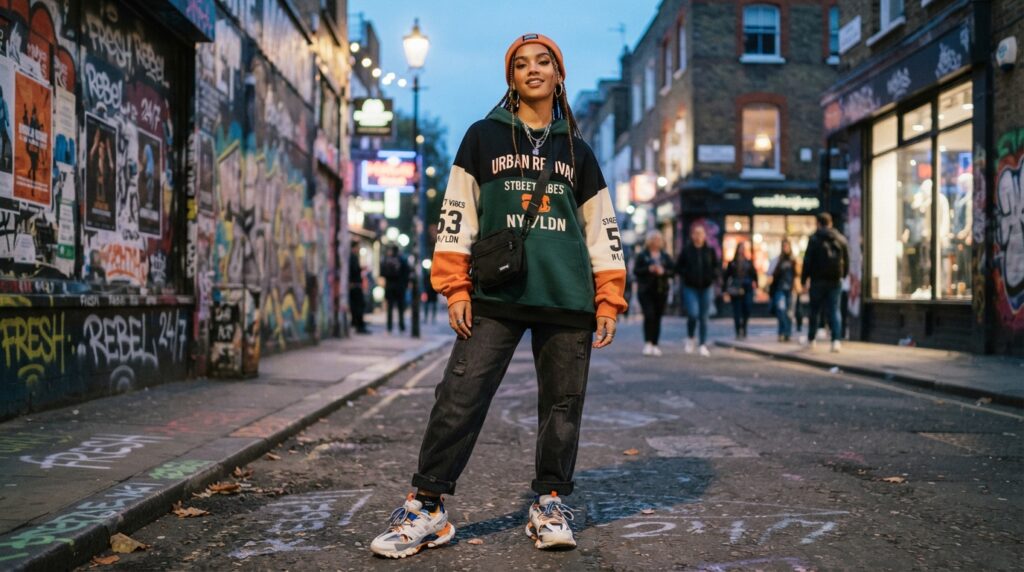
Gen Z fashion in 2026 is better understood as a mix of styles than as one named look. There is no single name for this set of trends and aesthetics. Creators can borrow a detail without following every trend.
| Trend or aesthetic | Defining look | Example or styling cue | Design detail to notice |
|---|---|---|---|
| Oversized or relaxed fits | Hoodies, pants, sweaters | “Big fit” | Loose garment form |
| Gender-neutral and inclusive fashion | Inclusive styling | Relaxed fit | Comfort and ease |
| Minimalist basics | Pared-back pieces | Simple line and shape | Few visual details |
| Vintage and Y2K revival | Retro cues | Retro hat, athletic wear, bulky shoes | Mix of old and new |
| Sustainable choices | Reuse and altered clothes | Thrift-flip culture | Changed or reused pieces |
Gorpcore and cyber-minimalism are other named aesthetics in the trend mix. Each gives designers a different starting point, from outdoor-inspired clothing to pared-back looks with a high-tech feel.
New York and Los Angeles streetwear can combine urban style with a relaxed West Coast attitude. A creator might pair a loose hoodie with tailored pants, or add bulky shoes to a simple outfit.
These are trend descriptions, not a checklist every creator must follow. Choose a trend detail only when it supports the wearer’s comfort and the design’s overall unity.
How Can We Turn a Design Idea Into a Garment?
A quick sketch lets us test a design idea before we spend time constructing it. A four-step process can take us from the first drawing to a more finished garment. We should test fabric behavior on the body before final construction.
A toile or muslin is a test version of a garment, made before the final piece. It lets us check fit, proportion, and how the fabric moves on the body.
Use a toile or muslin to check fit, proportion, and fabric behavior before making the final garment.
- Sketch the concept and mark the focal point.
- Choose materials for the intended silhouette and feel.
- Make a toile or muslin to check fit and proportion.
- Refine seams, details, and the focal point.
During the test, notice whether the material holds its shape or falls softly. A fabric that behaves differently from the sketch may call for a changed seam or revised shape.
Recheck the fit and focal point on the prototype before finalizing the garment.
Conclusion
We can use design principles as practical checks, not rigid rules. A stronger garment has a clear focal point, and each detail supports the whole. That check can help us decide what to keep, move, or remove.
Before choosing materials, sketch one garment and mark its focal point. Then review its balance and proportion, and note one detail that needs a change. Start with one sketch and make one deliberate change after reviewing its focal point, balance, and proportion.