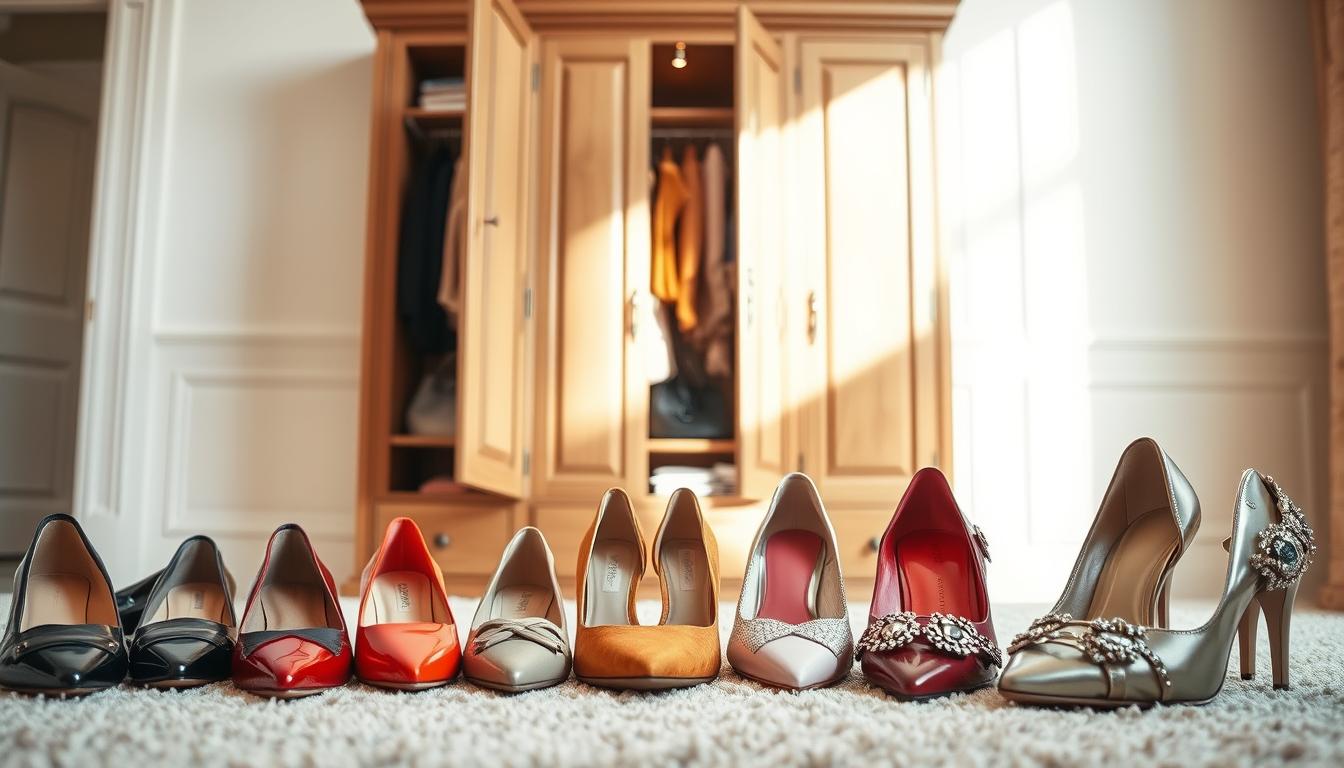
A well-chosen pair can change the feel of an outfit without requiring a sky-high heel. Our Best Luxury Shoe Brands for Women shortlist is for anyone weighing comfort, investment, pricing, and style. The choice should fit the way we dress and the places we go.
Luxury can mean a polished flat just as much as a high heel. Design matters, but so do craftsmanship, fit, and the occasion. A shoe that looks striking on a shelf may not earn its place if it pinches or suits only one outfit.
We can use this selection to compare recognizable designs with practical needs. Consider how often we will wear a pair, what it will match, and how it feels on our feet. The most useful shortlist starts with the styles we will wear and the details we value.
Key Takeaways
- Choose a shoe for fit, construction, design, and its intended use.
- Luxury footwear includes comfortable flats and loafers, not only heels.
- Signature details can make a shoe memorable but less versatile.
- Compare the exact style and materials before judging its price.
- Try shoes on and walk in both before making a decision.
What Makes a Luxury Shoe Worth Choosing?
A luxury shoe is worth choosing when its construction and design serve the way we actually plan to wear it. The shaped form around which a shoe is built is called a last. Fit, materials, construction, and likely use matter more than a famous label alone.
A last helps shape the shoe, so its form affects the fit and look. Footwear design training can cover lasts, patternmaking, sewing, construction, finishing, materials, and ergonomic fit, as described in the FIT accessories design course catalog.
Judge the shoe by its construction, materials, fit, design, and likely use, not by its label alone.
Use this five-point checklist to compare shoe brands. A distinctive look can help us find a style we love, but a logo cannot prove a shoe will feel good or last.
- Construction: Check the sole, seams, joins, and finish.
- Material: Look at the upper, lining, and sole materials.
- Fit: Check toe room, heel hold, and pressure points.
- Signature design: Decide whether the details suit our wardrobe.
- Cost per wear: Consider how often and where we expect to wear it.
Casadei’s Blade Heel uses a metallic structure that gives it a clear design identity. Gucci’s footwear includes horsebit loafers and embellished platforms, two very different fashion statements.
A strong design does not mean a higher price guarantees better quality. Before committing, check the sole, seams and fit as carefully as the name on the box.
Best Luxury Shoe Brands for Women
For a first luxury shortlist, we would start with Louboutin for a statement heel. Manolo Blahnik suits refined occasion pumps, while Prada brings a sharper modern look. These brands offer distinct design cues, but an iconic shoe may be less versatile than a quieter pair.
Choose a signature that works with the clothes we already wear. These five shoe brands offer useful starting points across statement heels, polished occasion styles, modern footwear, woven leather, and classic flats.
| Brand | Recognizable design | Useful style match |
|---|---|---|
| Christian Louboutin | Red-lacquered soles; So Kate and Hot Chick | Statement heels and visible design details |
| Manolo Blahnik | Hangisi satin pumps with jeweled buckle | Polished occasions |
| Prada | Chunky monolith boots, pointed slingbacks, geometric heels | Structured, modern outfits |
| Bottega Veneta | Intrecciato woven leather | Distinctive texture with a refined look |
| Salvatore Ferragamo | Vara flats with signature bow | Classic flats and everyday outfits |
Louboutin’s red soles make its shoes an unmistakable statement choice. Manolo Blahnik’s Hangisi adds a jeweled buckle and satin finish to an occasion pump. Prada suits structured outfits, while Bottega Veneta’s intrecciato, a leather-weaving technique, creates a recognizable woven detail.
Ferragamo’s Vara gives us a classic flat with a signature bow. Other designs to explore include Jimmy Choo’s heels, Maison Margiela’s Tabi, Valentino Garavani’s Rockstud, and Hermès’ Oran sandals.
A famous silhouette can be memorable yet difficult to pair with many outfits. Choose the signature that fits your wardrobe rather than buying a famous silhouette for its name alone.
Who Is Jimmy Choo, and How Did His Label Begin?
Jimmy Choo is a Malaysian fashion designer whose route to international recognition began with handmade shoes and formal training in London. He made his first pair, slippers, at age 11. His early work began with craft, not a global fashion company.
Jimmy Choo the designer and Jimmy Choo Ltd. are distinct. Choo Yeang Keat was born on November 15, 1948, in Bukit Mertajam, in what was then the Crown Colony of Penang.
He studied at Cordwainers Technical College in London from 1982 to 1984. Attention at London Fashion Week in 1988 brought notice to his craftsmanship and designs, followed by an eight-page spread in Vogue.
Tamara Mellon began working as an accessories editor and assistant at British Vogue in 1991. In 1996, she and Choo co-founded Jimmy Choo Ltd., the company that grew from the designer’s craft.
By 2001, Jimmy Choo Ltd. had more than 100 retail clients, including Harrods, Harvey Nichols, Saks Fifth Avenue, and Bergdorf Goodman. That year, Choo sold his 50% stake for £10 million.
He later focused on an exclusive couture line produced under license from Jimmy Choo Ltd. The company is known for handmade women’s shoes, while the designer continued his couture work after selling his stake.
The designer and the company have been distinct since he sold his stake in 2001 and continued with his couture line.
Which Luxury Flats and Loafers Work for Everyday Wear?
For an everyday flat, Rothy’s stands out for machine-washability, while Nomasei offers a leather ballerina with a small block heel. Each answers a different daily need, from easy cleaning to a more dressed-up feel.
Pick a flat by its material, shape, and use, not by the label alone. This comparison covers washable flats, ruched leather, a concealed wedge, backless loafers, and hard-wearing everyday styles.
| Brand | Style | Design or material detail | Everyday-use appeal |
|---|---|---|---|
| Rothy’s | Signature flats | Material crafted from plastic waste | Described flats are machine-washable |
| Nomasei | Flip ballerinas | Leather, ruched edge, small block heel | A soft-edged polished option |
| Essen | Pointed Flat | Off-center vamp, concealed wedge | Pointed look with hidden lift |
| St. Agni | Backless loafers and slip-ons | Low-profile shapes, plus sandals | Easy slip-on styles |
| Vagabond | Everyday shoes | Launched in 1993; family shoemaking roots from the 1970s | Hard-wearing styles for regular use |
Rothy’s washable flats suit days when easy cleaning matters. That feature applies to the described Rothy’s flats, not to luxury shoes in general. Nomasei’s ruched leather ballerina has a small block heel for a more shaped look.
Essen’s Pointed Flat has an off-center vamp and concealed wedge, adding lift without an obvious heel. Essen’s Pump, new for autumn/winter 2026, has a heel designed to be neither chunky nor spindly.
St. Agni’s range includes sandals, backless loafers, and slip-ons. Vagabond’s family shoemaking roots reach back to the 1970s, before the brand launched in 1993.
Check the care instructions before choosing a pair you expect to wear on repeat.
Which Boots and Sandals Suit Different Wardrobes?
A.Emery is a useful starting point for a minimalist wardrobe. The removable shafts on the AW26 Charles & Keith boot offer two looks in one. One stays pared back, while the other changes shape.
Choose a clear silhouette or a convertible design based on how you dress. Australian and Singaporean labels bring different design contexts, not a measure of which country’s footwear is better.
Boots with Minimal or Convertible Details
Australian brand A.Emery began as a specialist in simple black sandals. Its Jude is a knee-high boot, while the Grace is an ankle boot with a pared-back look.
The AW26 Charles & Keith boot has removable shafts. Take them off, and the boot converts into a chunky Mary Jane-style sneaker. Charles & Keith began as a single footwear shop in Singapore, founded by brothers Charles and Keith Wong in 1996.
Sandals and Statement Western Styles
A.Emery’s simple black sandals suit outfits built around clean lines. Paris Texas offers a more dramatic direction with cowboy boots and spiky slingbacks.
The options range from an uncomplicated sandal to a boot that draws attention. A convertible design may not suit us if we want a simple, uninterrupted silhouette. Its extra parts can change the look rather than keep it plain.
Think about the outfits each pair needs to serve. Versatility is useful only when we want it, while a clearly defined boot may feel more at home in a focused wardrobe.
Decide whether you want one adaptable pair or a clearly defined boot or sandal before weighing the details.
Which Designer Heels Suit Weddings and Special Events?
Gianvito Rossi’s pointed 105 suede pumps are a polished starting point for weddings and other formal events. Their clean shape works with dressy outfits without adding extra decoration.
Match heel shape to the venue and the time we expect to spend standing. A narrow heel may sink into grass or feel unstable on uneven ground.
A pointed suede pump gives an outfit a neat, formal line. Amina Muaddi’s designs take a more decorative path, with pyramid-heel pumps and pointed slingbacks featuring jeweled brooches.
Malone Souliers is known for court shoes and mules with cutaways, straps, and buckle details. Those openings and accents create a different statement from a plain pump.
Before choosing, check these three details:
- Venue surface: grass, stone, floors, or uneven ground.
- Time standing: a brief ceremony or a long reception.
- After-event use: whether the shoes work with another outfit.
Match heel shape to the venue underfoot, not just to the photograph you want. A narrow heel can look elegant in a picture and still be a poor match for a lawn.
Which Brands Make Distinctive Statement Shoes?
Neous and Nodaleto show two different routes to a statement shoe, one architectural and the other deliberately retro. Neither relies on a standard pump shape, so we should consider what each pair will match.
An unusual silhouette earns its place when it works with clothes we own. Check our wardrobe before choosing a design that may be hard to style.
Sculptural Shapes and Unusual Details
Vanissa Antonious, a former Harper’s Bazaar editor, founded Neous in 2017. The brand is known for sculptural silhouettes and architectural heels that make shape the main design feature.
Dirt offers a different kind of statement through molded tread soles and athleisure fabrics. Its designs draw on sporty details rather than the hard lines of an architectural heel.
Retro and Romantic Styles
Beste and Merve Manastır founded Manu Atelier in 2014, starting with handbags. The brand added shoes five years later, including the Duck Boot and AW26 XX Mules.
Nodaleto’s Bulla Babies have exaggerated flared heels, square toes, and high-shine patent leather. The Mary Jane shape feels retro, while glossy patent leather adds a bolder finish.
Do not buy an unusual silhouette without checking what it can pair with in an existing wardrobe. A standout shoe can feel isolated if none of our outfits support its shape.
Try to name two outfits that could use the pair before we decide. A sculptural heel, patent leather, or molded sole can add character, but not every statement fits every closet.
A distinctive pair earns its place when at least two outfits in our closet can use it.
What Are the World’s Most Expensive Shoes?
The $17 million Jada Dubai and Passion Jewellers Passion Diamond Shoes are the highest-priced pair in this comparison. They feature 236 diamonds, gold, and silk. These are collectible showpieces, not a guide to everyday luxury footwear.
Jewels, precious materials, bespoke design, and links to famous people or objects drive the spectacle. The listed prices reflect extraordinary creations rather than ordinary designer shoes.
| Shoe | Listed price | Defining materials or detail | Relevant context |
|---|---|---|---|
| Jada Dubai and Passion Jewellers Passion Diamond Shoes | $17 million | 236 diamonds, gold, and silk | Two names for the listed jeweled shoes |
| Debbie Wingham’s heels | $15.1 million | Three-carat pink diamonds, one-carat blue diamonds, platinum body, 24-carat gold paint | Precious materials define the design |
| Harry Winston Ruby Slippers | $3 million | 4,600 rubies totaling 1,350 carats and 50 carats of diamonds | A jeweled take on ruby slippers |
| Stuart Weitzman’s Rita Hayworth heels | $3 million | A pair of earrings belonging to Rita Hayworth | Uses jewelry tied to an iconic wearer |
| Stuart Weitzman’s Cinderella Slippers | $2 million | 565 Kwiat diamonds set in platinum | Alison Krauss wore them to the 2004 Oscars |
The listed $17 million price for the Passion Diamond Shoes puts them above the other examples here. Their value comes from rarity and materials, not from the needs of a practical wardrobe.
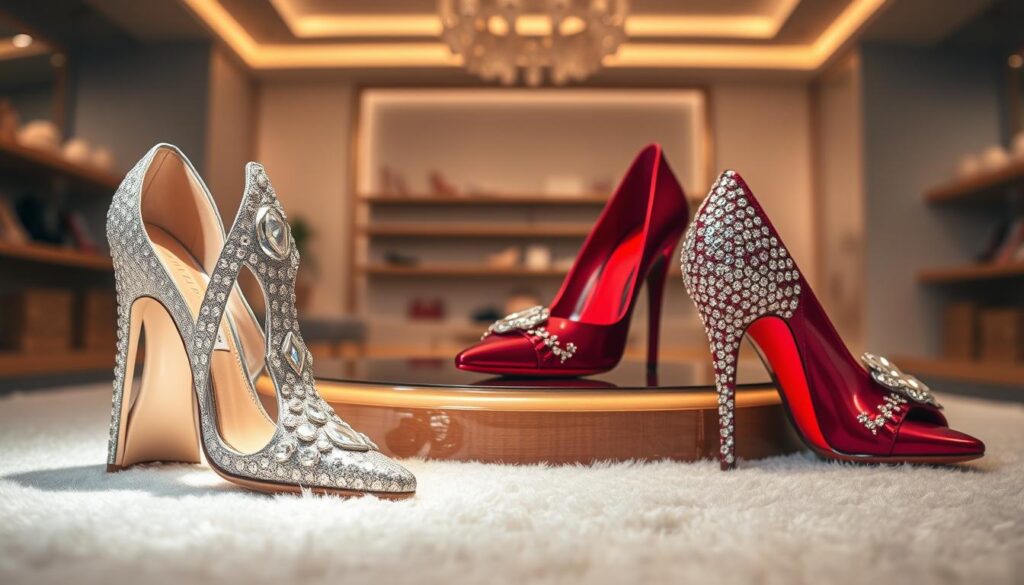
Alison Krauss wore Stuart Weitzman’s Cinderella Slippers to the 2004 Oscars. The pair has 565 Kwiat diamonds set in platinum, while Rita Hayworth’s heels include her own earrings.
Treat these jeweled showpieces as collectible statements, not as a benchmark for a practical wardrobe purchase.
What Was the First Footwear in the World?
The Areni-1 shoe, found in Armenia in 2008, dates to about 3500 BC and is the oldest leather footwear known to contemporary researchers. It is a one-piece leather-hide shoe, not a modern luxury design.
That precise claim does not prove it was the first footwear ever made. Shoes made from other materials may not survive as well, so the known leather example is not the same as the first shoe people wore.
The Areni-1 shoe is about a United States and Canada women’s size 7. It is also described as European size 37 or United Kingdom size 6.
Those size comparisons can help us picture the shoe’s scale, but they do not identify its wearer. Archaeologists could not determine whether the shoe belonged to a man or a woman.
Its approximate size is informative, but it cannot tell us whether the wearer was a man or a woman.
What Are the Main Types of Women’s Shoes?
The most useful basic shoe-type names are ballet flats, loafers, pumps, slingbacks, sandals and boots. These terms describe shape, so they help us compare styles even when brand names differ.
A pump has a heel and closed construction, while a flat sits low and a slingback has a rear strap. A brand’s product name may not reveal the shoe type clearly, so check the actual shape.
- Ballet flats: Low, closed shoes inspired by ballet slippers.
- Loafers: Slip-on shoes with a closed upper and low heel.
- Pumps: Closed shoes with a raised heel and open top.
- Slingbacks: Shoes held at the back by a strap.
- Sandals: Open shoes held by straps or other supports.
- Boots: Shoes that cover the ankle or extend higher up the leg.
These names describe common women’s shoe types, but they do not cover every design. A loafer can have a thick sole, and a sandal can have a high heel.
Footwear styles also reflect local traditions. Japanese geta, South Asian jutti, and espadrilles are recognizable styles from different parts of the world, and they are not all luxury shoes.
Naming the silhouette first makes it easier to compare design details across brands. The shape gives us a clear starting point for discussing the upper, heel, and sole.
Which Luxury Shoes Are Most Comfortable for All-Day Wear?
For long days on our feet, a well-fitting flat or low, stable heel is usually a safer starting point than a narrow high heel. A steady base often helps during extended walking.
A famous label cannot make up for rubbing, pressure, or a poor fit. Comfort depends on foot shape and how the shoe holds the foot.
Flats and Low Heels for Longer Wear
Ferragamo’s Vara bow ballet flats and loafers are styles to try, not guaranteed comfort winners. A flat or low heel can be easier to walk in for longer than a high, narrow heel.
Fit Checks That Matter More Than the Label
Leave about a thumb’s width of space at the toe as a general fit guide. The right amount can vary with foot shape and the shoe’s design.
Check that the heel stays secure without rubbing. Try shoes on later in the day, when feet may feel different after hours of activity.
Walk around in both shoes before buying and reject any pair that pinches or slips. Comfort is personal, so our feet must make the final call.
How Much Do Luxury Shoes Cost?
Jimmy Choo shoes are typically listed in an average price range of $500 to $1,500. That is a brand-specific range, not a rule for every luxury shoe.
Materials, embellishment, construction, and style affect the price of an individual pair. A simple flat and an embellished heel may sit at different points, even within one brand.
Before we compare prices, check:
- Compare the exact style, not just the brand name.
- Check the materials and construction details.
- Consider how many times we expect to wear the pair.
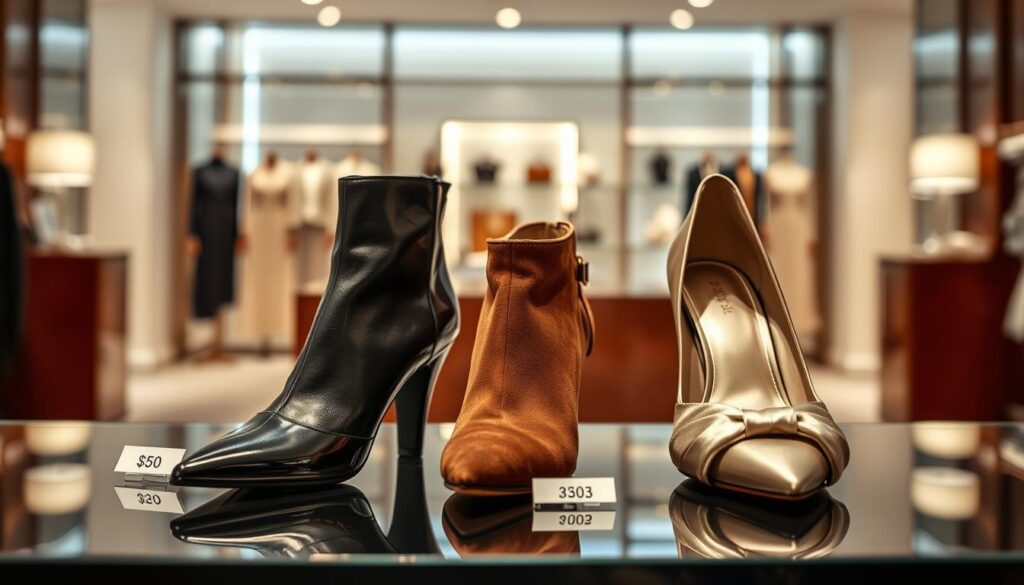
Use the expected wears to think about value, but do not treat frequent use as the only reason to buy. A special pair may serve a clear purpose even when we wear it less often.
Compare the exact shoe and its construction rather than assuming every luxury label sits in the same price bracket.
Which Mid-Luxury Shoe Brands Offer a Polished Alternative?
Mid-luxury labels can be a useful middle ground, but their price examples and production details are not directly interchangeable. These examples vary by style, currency, and product page.
Mid-luxury is a practical comparison category, not a promise of identical construction across brands. A lower listed price does not automatically mean better value if fit or durability is poor.
| Brand | Example price and currency | Stated production or material detail |
|---|---|---|
| ATP Atelier | Loafers €390-€490; boots €650-€690 | Prices vary by style |
| Sézane | Ballerinas around £170 | Some product pages identify Portuguese workshop production |
| Reformation | Price varies by style | Made in Brazil; references LWG-rated leather |
| Tony Bianco | Many pairs around $120-$220 | Established in 1972 |
| BY FAR | Boots €460-€530 | Prices vary by boot style |
Reformation’s 2021 shoe relaunch used traceable fabrics. The brand reported 70% less water and 52% fewer CO2 emissions than its stated average shoe comparison.
The figures offer context for specific products and brand claims, not a direct measure of every pair. The currencies also differ, so compare within the currency and style we plan to buy.
Compare a specific pair’s materials, construction and fit before treating a lower price as a better buy.
How Should We Choose a Shoe Brand for Our Style and Budget?
Start with the outfits and occasions we need to serve, then compare brands that make the right silhouette. Our wardrobe sets the test, not a label’s fame or price.
Use a three-part shortlist: fit, construction, and intended occasion. Cost alone cannot show how often or where a shoe will work for us.
When One Versatile Pair Matters Most
Test a potential investment by checking whether it works with two main outfit categories. A pair that suits workwear and casual outfits may have a broader role than one that fits only one look.
Think about color, heel height, and the way the upper meets the foot. Small design choices can decide whether we reach for the pair or leave it unworn.
When a Statement Pair Is the Priority
A distinctive heel or unusual boot may be right for events or personal expression, even if we wear it less often. A statement shoe does not need to be the most-used pair to earn a place.
Billionaire wardrobes do not follow one universal shoe style. They may include practical flats, classic designer shoes, and statement pieces, just as other wardrobes can.
Do not treat cost as a substitute for matching shoes to their use. An expensive label cannot tell us whether a pair suits our feet or the places we go.
Use this final checklist:
- Confirm the fit by walking in both shoes.
- Identify the occasions the pair will serve.
- Decide what wardrobe gap the shoe fills.
Keep the pair that fits comfortably and earns a clear place in the wardrobe, whatever its label.
How Do We Care for Luxury Shoes Between Wears?
Good care starts with letting a damp pair dry naturally instead of placing it beside direct heat. Slow drying protects the material from harsh temperature changes.
Let damp leather footwear dry naturally for about 24 hours before wearing it again. Keep shoes away from direct heat while they dry.
Let damp leather shoes dry naturally for about 24 hours, and keep them away from direct heat.
Cedar shoe trees can help leather shoes retain their shape between wears. Store shoes in a cool, dry place, and use products made for the material.
Suede and patent leather need material-appropriate care rather than the same polish used on smooth leather. A product that suits one finish may harm another.
Test any care product on a discreet area and follow the instructions for that material.
Conclusion
The right luxury pair is the one that combines a design we love with fit and use we can justify. Personal style matters, but so do comfort and the occasions the shoes will serve.
We can start with one silhouette we genuinely want, then shortlist three brands that make it. Try on the styles that fit the budget, and walk around in each pair before choosing.
Start with three brands and one silhouette, then choose the pair that feels right on foot.